Ceramic contact surfaces
Liners and selected components reduce direct metal contact in critical areas.
Low-Contamination Grinding
A ceramic-lined jet milling and classification system for high-purity powders and materials with strict metallic-contamination limits.
Process Overview
Low contamination depends on more than one ceramic liner. The milling chamber, classifier wheel, nozzles, conveying path, valves, collection parts, sealing structure, and maintenance method must be reviewed as one system.
Final configuration is determined from representative powder data, required product quality, throughput, operating environment, and safety information.
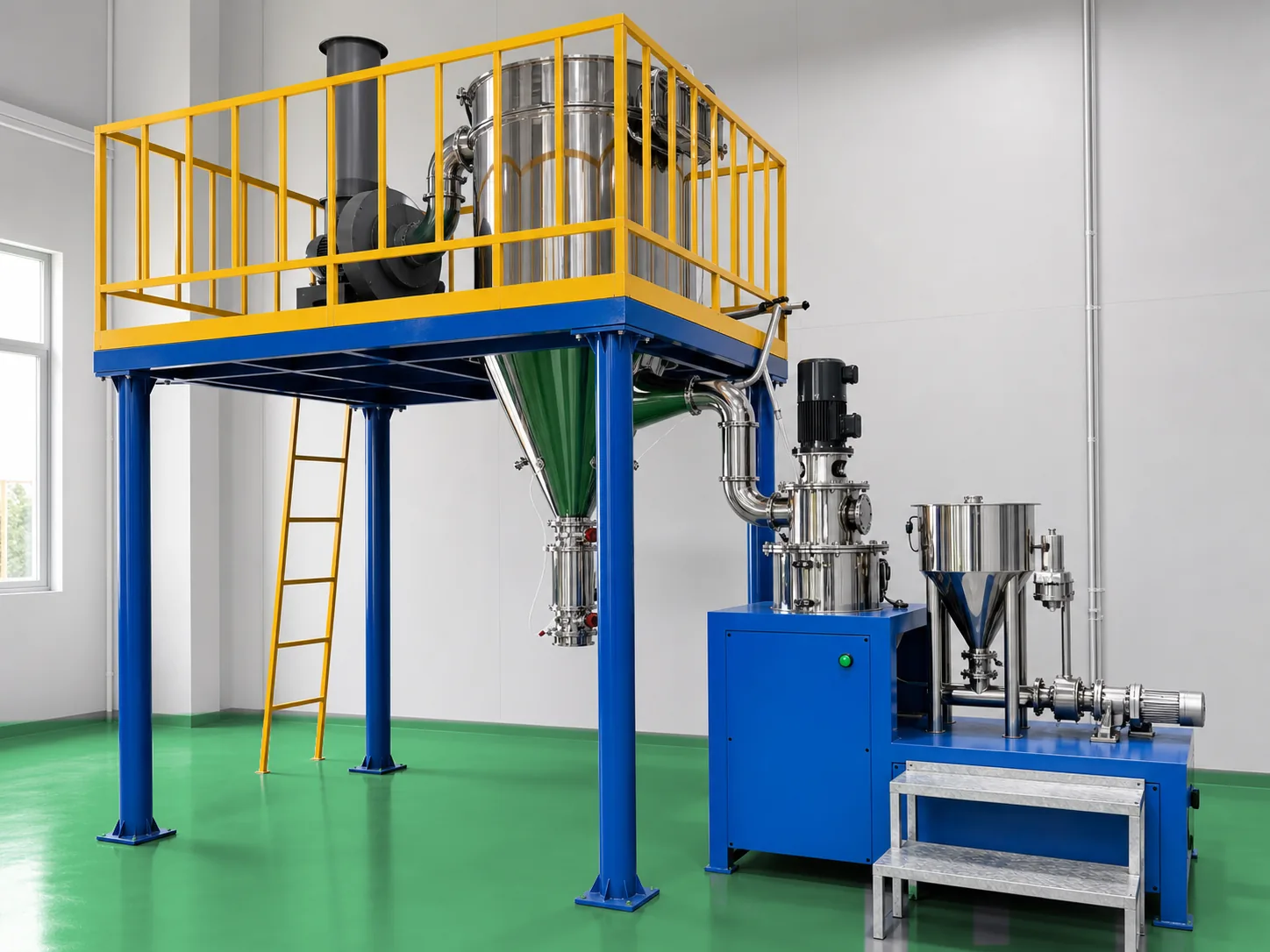
Each item is reviewed against the real powder and acceptance criteria.
Liners and selected components reduce direct metal contact in critical areas.
Compressed gas provides grinding energy without mechanical grinding media.
Classifier speed and airflow control the final particle-size distribution.
Sealed collection and suitable filters help reduce secondary contamination.
Ceramic grade and protected area are selected from hardness and impurity limits.
Trials and inspections establish practical wear and maintenance boundaries.
Battery cathode and anode powders, alumina, zirconia, silicon nitride, electronic ceramics, pharmaceutical powders, and other high-purity materials.
Application examples are not a guarantee for an untested powder. Chemical compatibility, dust risk, and required product properties must be confirmed first.
Send the material name, SDS, feed PSD, target D50/D90/D97, capacity, impurity limits, temperature limit, and atmosphere requirements.
Submit Material Data| Factor | Typical Requirement | Engineering Note |
|---|---|---|
| Primary objective | Lower metal pickup | Defined by impurity limits |
| Protected components | Chamber, wheel, nozzles, piping | Project-specific scope |
| Process | Jet milling + classification | Closed-loop option |
| Verification | PSD + contamination test | Use agreed test method |
No. It reduces selected contamination sources, while feed quality, seals, filters, handling, and cleaning still affect the result.
Alumina, zirconia, silicon carbide, and other options have different wear, purity, and cost characteristics. Selection follows the powder and impurity limit.
It provides particle-size, wear, buildup, cleaning, and collection evidence before the production configuration is fixed.
Testing helps establish achievable particle size, capacity trend, collection behavior, contamination risk, and the correct system boundary before production selection.
Scan to add WeChat
 Scan with your phone to start a chat