Applications · Metal Powders
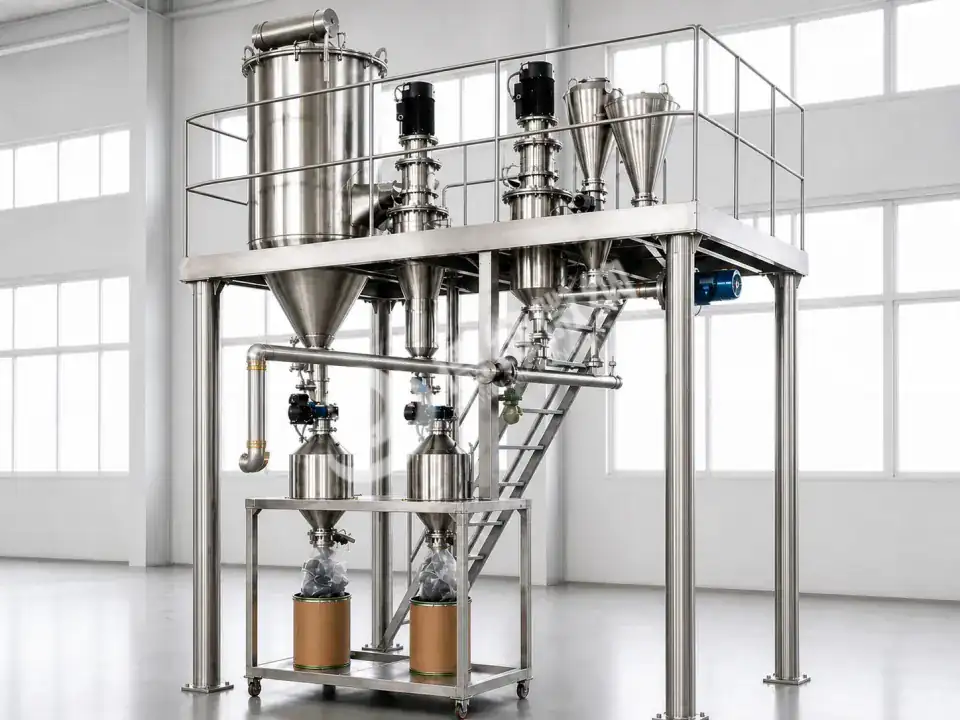
Metal Powder Milling under Inert Gas
For metal powders that are sensitive to oxidation or present combustible-dust hazards, milling and classification must be assessed together with the gas atmosphere and powder transfers. A closed-loop nitrogen or argon system can combine milling, classification and collection. Gas selection, oxygen monitoring and interlocks are defined for the specific material and operating conditions.
- Confirm gas compatibility and the atmosphere needed by the powder.
- Assess oxygen monitoring, sealing and interlocks across the complete system.
- Review the SDS, dust-hazard data and site requirements before testing.
Related Equipment
These routes are starting points. The final configuration depends on material data and trial results.
Inert Gas Jet Milling System
Combines jet milling and collection in a recirculating protective-gas circuit.
View equipment →Inert Gas Mechanical Mill
Uses mechanical impact in an inert-gas circuit where that route suits the material and throughput.
View equipment →Gas Protected Air Classifier
Separates powder fractions while maintaining the specified protective atmosphere.
View equipment →Frequently Asked Questions
Does every metal powder need inert gas protection?
No. Oxidation sensitivity and dust hazards vary by material. The decision should use the SDS, relevant dust-test data and site requirements; the material name alone is not enough.
How is nitrogen or argon selected?
Selection starts with compatibility between the gas and the powder. Nitrogen supply and operating cost can be evaluated where appropriate; argon may be needed when nitrogen is unsuitable or the product specification requires it.
Can a fixed oxygen level be promised before engineering?
No. The achievable operating level depends on sealing, purging, circulation, feeding, discharge and site conditions. The target and its monitoring method must be defined and verified for the system.
What information is needed before a metal-powder trial?
Provide the composition, SDS, available dust-hazard data, feed and target particle sizes, required throughput and atmosphere limits. These allow the team to assess the trial conditions and suitable milling route.
 Scan with your phone to start a chat