Air Classifier
Micro-Nano Air Classifier
A micro-nano air classifier configuration is intended for fine-powder separation where upper-size limits, dispersion, and recovery must be considered together. Confirm feasibility with representative feed and an agreed measurement method.
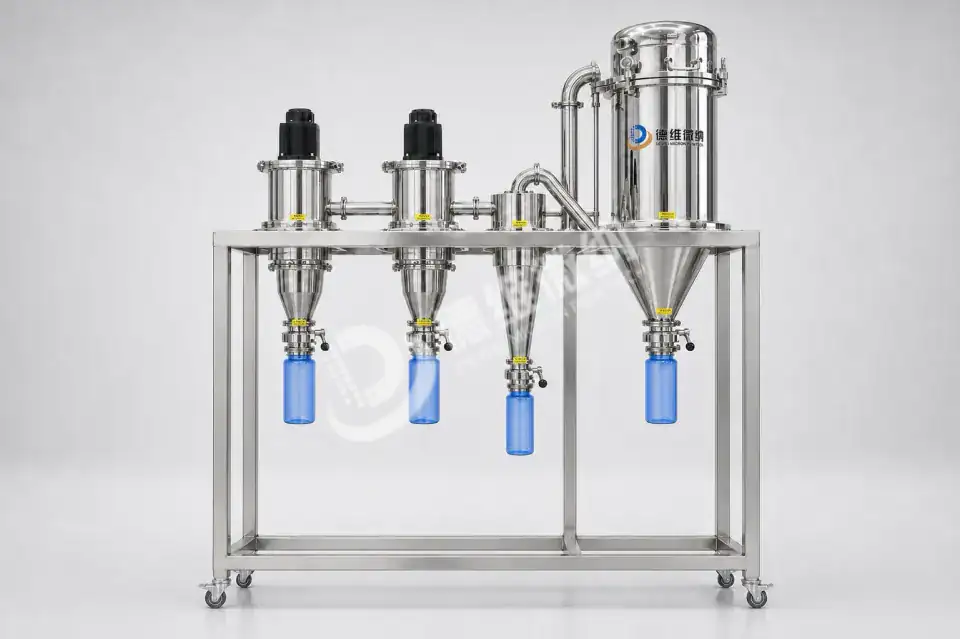
Assess fine separation beyond a single size value
Fine particles can behave as agglomerates rather than isolated particles. Feed dispersion, material properties, classifier settings, and collection must be reviewed together. A smaller stated cut point does not establish useful throughput or recovery by itself.
- Share feed and target distributions, including the measurement method.
- Define minimum acceptable recovery and how coarse powder will be handled.
- Review moisture sensitivity, agglomeration, wear, and fine-powder collection.
Working Principle
Process Flow
Uniform Suspension
Centrifugal Force Field
Classifier Wheel
Collection
Key Features
Precise Cut-Point Control
Stepless classifier speed adjustment. In the micro-nano configuration the D97 cut-point reaches down to 0.5 µm, with high batch-to-batch consistency.
High Classification Efficiency
Advanced blade design and airflow organization. Sharp coarse-fine separation with narrow particle size distribution in product.
Standalone or Integrated Operation
Can classify incoming powder independently, or integrate with a jet mill to form a closed-loop grinding-classification system.
Classification Without Intentional Grinding
Air classification separates particles rather than intentionally grinding them. Contact-surface wear and material carryover still require review for high-purity applications.
System-Level Utility Review
Assess the fan, feeding, collection, and any connected mill together when comparing utility requirements and operating cost.
Wide Capacity Range
DWF series covers 5–8,000 kg/h. Suitable from laboratory scale to large industrial production.
Applications by Use Case
| Use Case | Typical Materials |
|---|---|
| Ultrafine Powder Size Control | Calcium carbonate, kaolin, talc, barium sulfate |
| Battery Material Classification | Cathode materials, anode graphite, solid-state electrolytes |
| Pharmaceutical Particle Size Control | API final particle size control, coarse particle removal |
| Fine Chemicals | Catalysts, specialty coating pigments & fillers, flame retardants |
| Ceramic Powders | Alumina, zirconia, silicon carbide classification and coarse removal |
Model Specifications
The micro-nano configuration shares the DWF series main units with the standard configuration; the difference lies in classifier wheel speed range, number of stages, and collection setup — the standard configuration reaches D97 5 µm, while the micro-nano configuration goes down to D97 0.5 µm. See the series page for the complete model, capacity, and feed size table.
Request a Classification Solution
Provide the feed particle size distribution, target cut-point, and capacity. We will recommend the right model and arrange a classification trial.
- Feed particle size distribution (D50/D90/D97)
- Target cut-point (fines D97 upper limit)
- Hourly capacity and product yield requirement
- Whether closed-loop integration with a jet mill is needed
Contact Us
Submit your classification requirements. We will recommend a model and arrange a trial to confirm classification performance.
Submit Classification Enquiry Book a Classification TrialPhone: +86-816-2680206
Frequently Asked Questions
Should I buy a standalone classifier or a combined grinding + classification system?
If the incoming feed particle size is already close to target but you need precise control of the upper particle size limit, a standalone classifier is often sufficient. If you need to grind from coarser raw material to ultrafine powder, a grinding + classification combination is typically needed. For a combined circuit, verify the final distribution and recovery through a representative trial.
What factors affect classification accuracy?
Key factors: classifier wheel speed (determines cut-point), system airflow (affects fine powder throughput), feed concentration (too high reduces accuracy), and material properties (density, morphology, flowability). Proper parameter setting results in narrower particle size distribution and more accurate D97.
How fine a powder can the air classifier separate?
In the micro-nano configuration the cut-point reaches down to D97 0.5 µm. The achievable lower limit depends on material properties (density, tendency to agglomerate) and configuration, so we recommend confirming feasibility through a sample trial first.
Can capacity be determined by model alone?
No. Actual capacity is significantly affected by feed particle size distribution, target cut-point, product yield requirement, and material properties. Capacity should be confirmed through a sample trial or engineer evaluation to avoid selection errors.
Why does the particle-size measurement method matter?
Sample preparation and dispersion can change the measured distribution of fine powders. Agree a method for feed and product samples so the process results can be compared consistently.
 Scan with your phone to start a chat