Applications · Fine Chemicals & Agrochemicals
Fine Chemical and Agrochemical Powder Processing
Pigments, agrochemicals and other fine-chemical powders vary widely in hardness, heat sensitivity and chemical compatibility. The process must balance particle-size distribution with dispersion performance, containment and stable feeding. We compare jet milling and mechanical impact routes, then configure classification and collection around the formulation and its acceptance criteria.
- Set particle-size targets using the required dispersion or application performance.
- Assess dust containment and handling requirements from the material SDS.
- Check contact-material compatibility, temperature rise and buildup in trials.
Related Equipment
These routes are starting points. The final configuration depends on material data and trial results.
Fluidized Bed Jet Mill
A route for fine grinding where temperature response and particle-size control need evaluation.
View equipment →Classifier Impact Mill
Combines mechanical impact with an internal classifier for suitable medium-hardness materials.
View equipment →Grinding & Classification Line
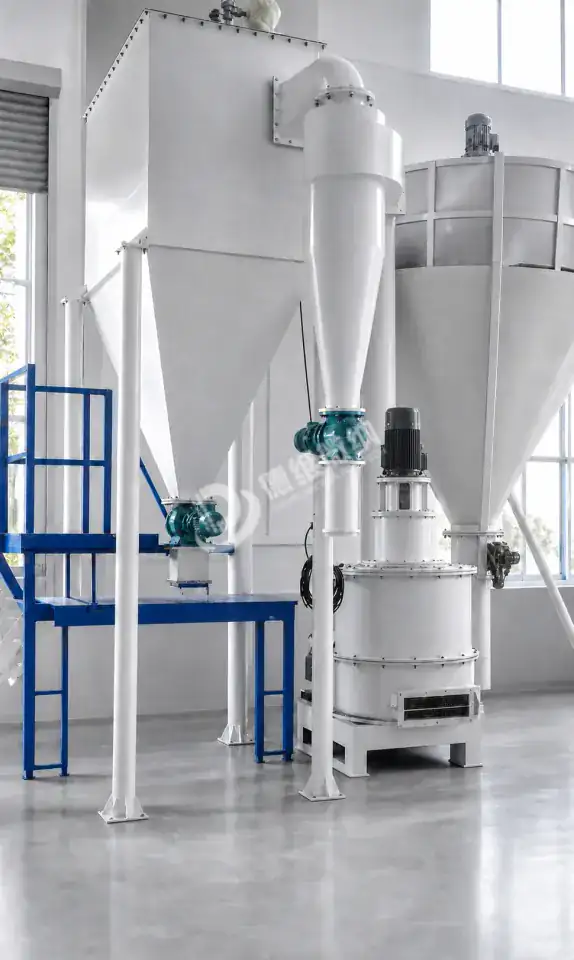
Integrates feeding, milling, classification, collection and dust control.
View equipment →Frequently Asked Questions
What should be checked when milling agrochemical powders?
Start with the SDS and handling requirements. Feeding, milling, collection and discharge need a containment review, with exhaust treatment and cleaning assessed for the formulation and site.
Can low-melting powders be jet milled?
They may be suitable, but melting behavior, temperature rise and wall buildup need testing. Cooling options can be evaluated after the material limits and trial results are known.
How should the target size for a pigment be chosen?
Compare trial samples at different particle-size distributions against the required dispersion and optical performance. The finest sample is not automatically the best production target.
How do you choose between an impact mill and a jet mill?
Compare the required particle size and throughput with material hardness, temperature sensitivity and contact-material compatibility. Trial results help determine which route gives stable operation for the formulation.
 Scan with your phone to start a chat