Grinding & Classification Line
Grinding & Classification Line
Integrate feeding, milling, classification, collection, and controls into a powder processing line. Select the process route and equipment around material properties, product specifications, utilities, and site requirements.
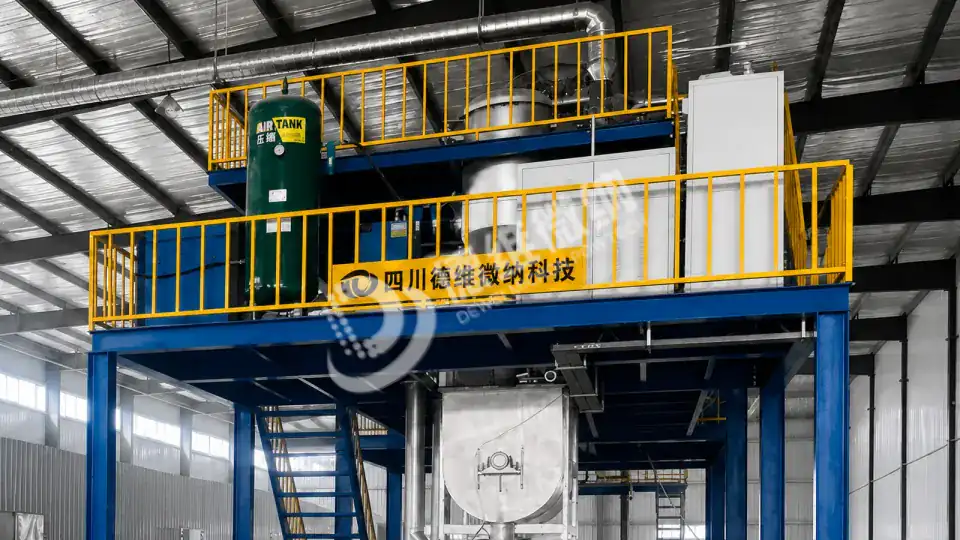
Configure the complete process around your powder
A complete line needs more than a mill capacity figure. Define the incoming material, finished product, production duty, and collection requirements together. Trial data and site conditions provide the basis for the equipment and layout proposal.
- Set particle-size, throughput, recovery, contamination, and cleaning requirements.
- Provide floor area, headroom, utilities, and collection or packaging interfaces.
- Agree supply, controls, installation, commissioning, and support responsibilities.
System Composition & Process Flow
Process Flow
Feed & Metering
Ultrafine Grinding
Precise Separation
Bag Filter
Packaging & Discharge
System Features
Modular Design
Each functional unit is an independent module. Combine as needed — easy to expand, upgrade, or reconfigure for maintenance.
PLC Automatic Control
Touchscreen HMI, real-time monitoring of key parameters, remote monitoring and data logging supported.
Closed-Loop Process Options
Coarse powder can return to the mill where appropriate. Evaluate the effect on size distribution, throughput, and recovery during trials.
Inert Gas Compatible
A protected gas circuit can be assessed for compatible materials. The gas, sealing, instrumentation, and protective measures depend on the hazard review.
Defined Project Scope
Agree equipment supply, installation guidance, commissioning, training, and technical support responsibilities in the project proposal.
Test Before Select
Confirm process on small-scale trial first, then configure the production line based on actual test data, reducing start-up risk.
Industries & Typical Configurations
| Industry | Typical Materials |
|---|---|
| Battery & New Energy | Cathode (NCM, LFP), anode graphite, solid-state electrolyte grinding & classification lines |
| Advanced Ceramics | Alumina, zirconia, silicon carbide, silicon nitride ultrafine powder production lines |
| Pharmaceutical | API grinding and classification lines supporting GMP environment and cleanroom interfaces |
| Fine Chemicals & Minerals | High-capacity lines for calcium carbonate, talc, kaolin, barium sulfate |
| New Materials | Custom grinding-classification and inert gas protection system integration for functional powders |
System Configuration Modules
Production lines are configured to order. The following are selectable modules — specific selection is determined by material properties and process requirements.
| Module | Description |
|---|---|
| Feed & Metering Unit | Screw feeder / vibratory feeder / loss-in-weight feeder for stable feed control |
| Jet Mill (Main Machine) | Fluidized bed jet mill (DWQ series), includes built-in classifier wheel |
| Standalone Air Classifier | DWF series, standalone or inline use to further narrow particle size distribution |
| Cyclone Collection System | Cyclone separator for primary powder collection; recovery depends on the material and operating conditions |
| Bag Filter System | Final filtration selected around powder behavior, collection requirements, and applicable exhaust limits |
| Inert Gas Protection | Closed-loop N₂/Ar circulation for flammable or oxidation-sensitive materials |
| Automatic Control System | PLC + touchscreen, key parameter interlock protection, remote monitoring supported |
Request a System Solution
Grinding-classification line configurations vary widely by material and process. Standard pricing has limited meaning. Provide your project requirements and our engineer will develop a targeted solution and arrange a trial run.
- Material name, application, and safety risks
- Target particle size (D50/D90/D97) and throughput
- Whether inert gas protection or explosion-proof configuration is needed
- Site conditions: building, air supply, power
Contact Us
Submit your project requirements. Our engineer will arrange a technical discussion and trial run plan.
Submit Project Requirements Book a Trial RunPhone: +86-816-2680206
Frequently Asked Questions
What information is needed to purchase a production line?
Essential: material name and safety risks (flammable, oxidation-sensitive), target product particle size (D50/D90/D97 or residue specification), hourly capacity, continuous run duration. Supplementary: on-site air supply, building space, utilities, explosion-proof requirements, cleanliness requirements. The more complete the information, the more accurate the proposal.
What is the typical delivery lead time?
Delivery depends on the agreed equipment, materials, controls, testing, and service scope. Request a project-specific schedule after the technical configuration has been reviewed.
Is it possible to run a trial before placing an order?
Yes, and we strongly recommend it. A trial confirms target particle size achievability, capacity trend, and wear risk — making the production line configuration more targeted and reducing commissioning risk after start-up.
Who is responsible for installation and commissioning?
We provide installation guidance and on-site commissioning services, including equipment installation, system integration testing, production trial guidance, and operator training. Specific service scope and costs should be confirmed at the inquiry stage.
How is spare parts and after-sales maintenance handled?
We provide a wear parts list and recommended spare parts inventory. Common wear parts (nozzles, classifier wheels, filter bags, etc.) can be stocked in advance. Complete maintenance manuals are provided before equipment shipment, with remote technical support available.
Which site details are needed for a layout proposal?
Provide available floor area and headroom, access for installation and maintenance, utilities, and the incoming and outgoing material interfaces. Include site safety and environmental requirements in the technical review.
 Scan with your phone to start a chat