Integrated classifier
The internal classifier limits coarse particles and supports a narrower distribution.
Mechanical Ultrafine Grinding
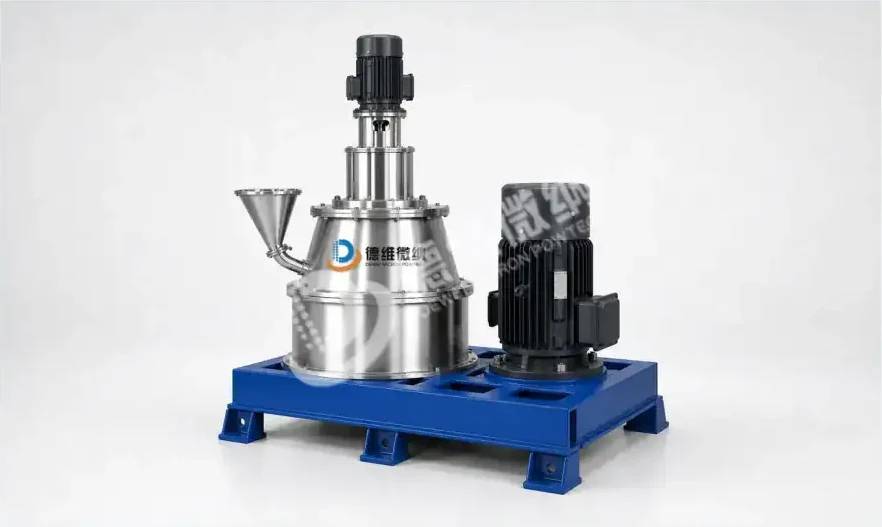
A high-speed impact mill with integrated classification for medium-hard, brittle, and selected heat-tolerant powders requiring continuous fine grinding.
Process Overview
Material is accelerated by a high-speed rotor and reduced by impact and shear. An integrated classifier controls the upper particle size while oversize particles return to the grinding zone. Rotor form, lining, classifier speed, and airflow are selected around the material.
Final configuration is determined from representative powder data, required product quality, throughput, operating environment, and safety information.
Each item is reviewed against the real powder and acceptance criteria.
The internal classifier limits coarse particles and supports a narrower distribution.
Pins, hammers, or other rotor structures can be evaluated for different fracture behavior.
Stable feeding and collection support production operation.
Selected contact materials or ceramic components can reduce wear and contamination.
Grinding and classification are combined to reduce the system footprint.
Testing establishes fineness, output, temperature rise, and wear risk.
Fine chemicals, pesticides, food ingredients, minerals, pigments, carbon materials, and other brittle or medium-hard powders.
Application examples are not a guarantee for an untested powder. Chemical compatibility, dust risk, and required product properties must be confirmed first.
Send the material name, SDS, feed PSD, target D50/D90/D97, capacity, impurity limits, temperature limit, and atmosphere requirements.
Submit Material Data| Factor | Typical Requirement | Engineering Note |
|---|---|---|
| Typical target | Fine to ultrafine powder | Depends on material fracture |
| Particle control | Built-in classifier | Speed-adjustable |
| Contact material | Metal or wear-resistant option | Selected by purity target |
| Selection inputs | Hardness, feed size, capacity | Trial recommended |
An impact mill uses a driven rotor, while a jet mill uses high-velocity gas and particle-to-particle collision. Purity, fineness, output, and energy priorities determine the route.
Some can, but temperature rise must be tested. A jet mill may be better when low-temperature grinding is critical.
Selected ceramic or wear-resistant contact parts can be configured after contamination and wear requirements are reviewed.
Testing helps establish achievable particle size, capacity trend, collection behavior, contamination risk, and the correct system boundary before production selection.
Scan to add WeChat
 Scan with your phone to start a chat