Applications · Ceramics & High-Purity Powders
Low-Contamination Milling for Ceramic and High-Purity Powders
Hard ceramic powders can introduce impurities through wear of nozzles, liners and other contact parts. Selecting a ceramic-lined route therefore starts with the impurities your product can tolerate, alongside the target particle size. Milling and classification are assessed together, with feed and finished-powder analysis used to check contamination and the coarse-particle limit.
- Select ceramic contact surfaces for the material and impurity limits.
- Control D97 and the remaining coarse fraction through classification.
- Compare feed and product analyses to assess wear-related contamination.
Related Equipment
These routes are starting points. The final configuration depends on material data and trial results.
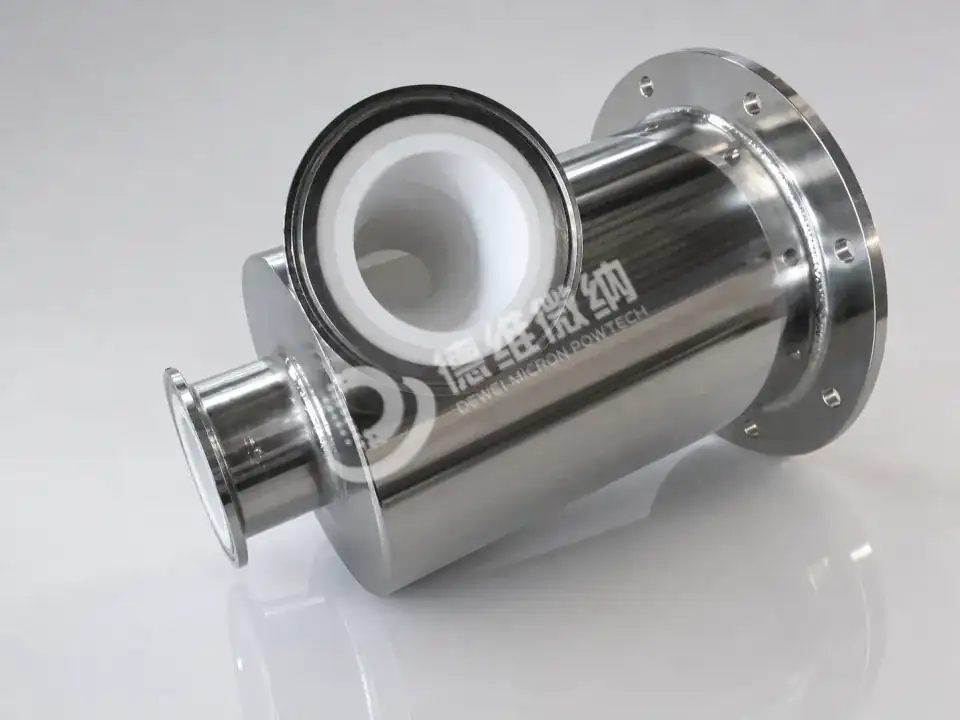
Ceramic-Lined Jet Mill
Provides ceramic contact-surface options for applications with strict metal-impurity limits.
View equipment →Fluidized Bed Jet Mill
Combines grinding and classification for hard, high-purity powders.
View equipment →Air Classifier
Controls the coarse fraction and separates the required product cut.
View equipment →Frequently Asked Questions
Does ceramic lining eliminate contamination?
No contact material should be assumed to contribute zero wear. The liner must be compatible with the product specification, and its contribution should be checked by comparing feed and finished-powder analyses.
How are lining materials selected?
Selection considers powder hardness, allowable impurities, wear and operating conditions. For example, a zirconia lining needs to be assessed against any limit on zirconium in the finished product.
Can different ceramic powders use the same milling settings?
Settings should be checked for each feed. Differences in hardness, density and feed size affect grinding behavior, wear and energy demand. Sample trials help establish a suitable operating range.
How fine can a high-purity ceramic powder be processed?
The attainable size depends on the material, feed size and system configuration. Provide the target D50 and coarse-particle limit so a trial can assess particle size, throughput and contamination together.
 Scan with your phone to start a chat