Sealed material path
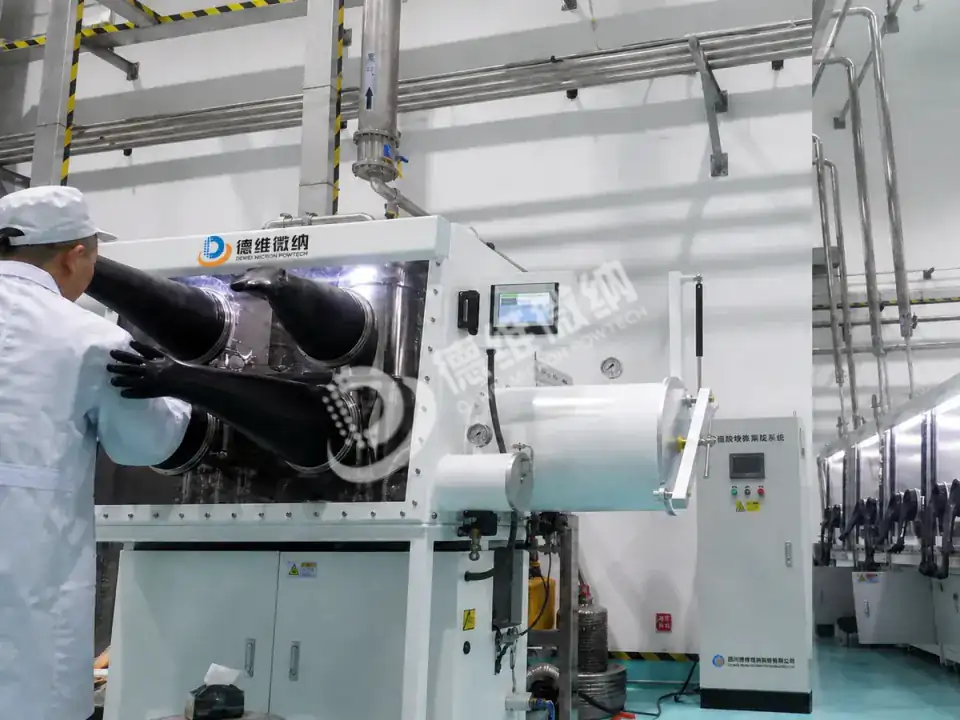
Feeding, grinding, classification, and collection can be integrated without open transfer.
Moisture- and Oxygen-Controlled Processing
A sealed, low-contamination milling and classification system for moisture- and oxygen-sensitive solid electrolyte powders.
Process Overview
Solid electrolyte processing may require controlled moisture and oxygen from feeding through milling, classification, collection, sampling, and discharge. The equipment route is therefore configured around the material chemistry, target distribution, contamination limit, exposure limit, and safe handling method.
Final configuration is determined from representative powder data, required product quality, throughput, operating environment, and safety information.
Each item is reviewed against the real powder and acceptance criteria.
Feeding, grinding, classification, and collection can be integrated without open transfer.
Purge, gas circulation, glovebox interfaces, and monitoring support the required atmosphere.
Ceramic contact parts and selected seals reduce unwanted metallic pickup.
Classifier control supports D50, D90, D97, or top-size targets.
Sampling and discharge interfaces are designed to limit environmental exposure.
Small-scale testing establishes grindability, collection, buildup, and process boundaries.
Sulfide, oxide, halide, and composite solid electrolyte powders, subject to material-specific safety and compatibility review.
Application examples are not a guarantee for an untested powder. Chemical compatibility, dust risk, and required product properties must be confirmed first.
Send the material name, SDS, feed PSD, target D50/D90/D97, capacity, impurity limits, temperature limit, and atmosphere requirements.
Submit Material Data| Factor | Typical Requirement | Engineering Note |
|---|---|---|
| Atmosphere | Low H₂O / low O₂ | Limit defined by material |
| Process | Milling + classification | Closed system |
| Purity option | Ceramic-protected contact path | By impurity target |
| Engineering inputs | SDS, PSD, exposure limits | Required before testing |
It may be possible only after chemistry, moisture reaction, gas-release, and facility safety requirements are reviewed.
Yes. Transfer, sampling, and discharge interfaces can be developed around the selected containment concept.
Define baseline and final analytical methods, then compare trial samples under agreed sampling and handling conditions.
Testing helps establish achievable particle size, capacity trend, collection behavior, contamination risk, and the correct system boundary before production selection.
Scan to add WeChat
 Scan with your phone to start a chat