Closed gas circuit
Nitrogen or argon can circulate through the classification and collection system.
Protected Classification
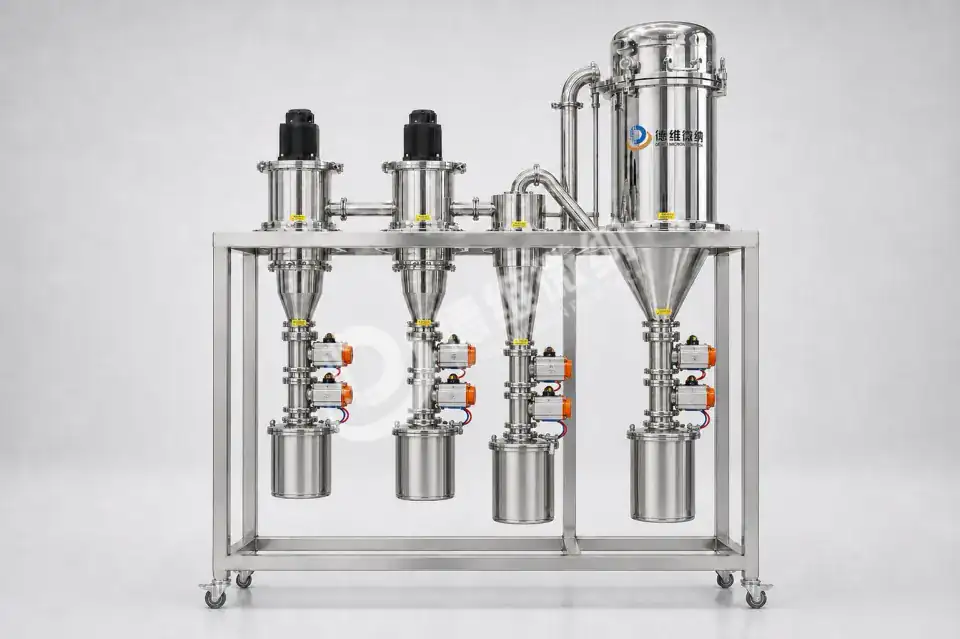
Precision air classification in a closed nitrogen or argon circuit for oxidation-sensitive, combustible, or moisture- and oxygen-sensitive powders.
Process Overview
The classifier separates fine and coarse particles by balancing centrifugal force and airflow. A sealed gas circuit, oxygen monitoring, pressure control, and safe discharge can be configured around the classifier when the powder cannot be exposed to normal air.
Final configuration is determined from representative powder data, required product quality, throughput, operating environment, and safety information.
Each item is reviewed against the real powder and acceptance criteria.
Nitrogen or argon can circulate through the classification and collection system.
Classifier speed and system airflow are tuned to the required D97 or top-size limit.
Online oxygen measurement and interlocks support a defined operating boundary.
Double valves or protected collection vessels reduce air ingress during discharge.
Can operate as a stand-alone classifier or in a closed loop with a mill.
Real material trials confirm yield, cut sharpness, gas demand, and product stability.
Active metal powders, solid electrolytes, carbon materials, oxidation-sensitive chemicals, and other powders requiring low-oxygen classification.
Application examples are not a guarantee for an untested powder. Chemical compatibility, dust risk, and required product properties must be confirmed first.
Send the material name, SDS, feed PSD, target D50/D90/D97, capacity, impurity limits, temperature limit, and atmosphere requirements.
Submit Material Data| Factor | Typical Requirement | Engineering Note |
|---|---|---|
| Cut-point target | D97 / top size | Confirmed by material testing |
| Working gas | Nitrogen or argon | Selected by material risk |
| System form | Stand-alone or closed loop | Matched to upstream milling |
| Key inputs | PSD, yield, O₂ limit | Required before sizing |
It should be evaluated when oxidation, combustion, moisture sensitivity, or product-quality limits make normal air unsuitable.
Yes. The classifier can be integrated with milling, feeding, collection, filtration, gas circulation, and control modules.
Classifier speed, airflow, feed rate, and powder behavior interact, so a representative material trial is the reliable basis.
Testing helps establish achievable particle size, capacity trend, collection behavior, contamination risk, and the correct system boundary before production selection.
Scan to add WeChat
 Scan with your phone to start a chat