High jet velocity
Steam conditions can provide higher energy density than conventional compressed air.
High-Energy Jet Milling
High-pressure steam jet milling for selected inorganic and heat-tolerant powders requiring high energy density and production capacity.
Process Overview
High-pressure steam expands through nozzles to produce high-velocity jets. Particle collision and classification provide ultrafine grinding, while the steam supply, thermal boundary, condensation management, drying, and downstream collection must be engineered as one process.
Final configuration is determined from representative powder data, required product quality, throughput, operating environment, and safety information.
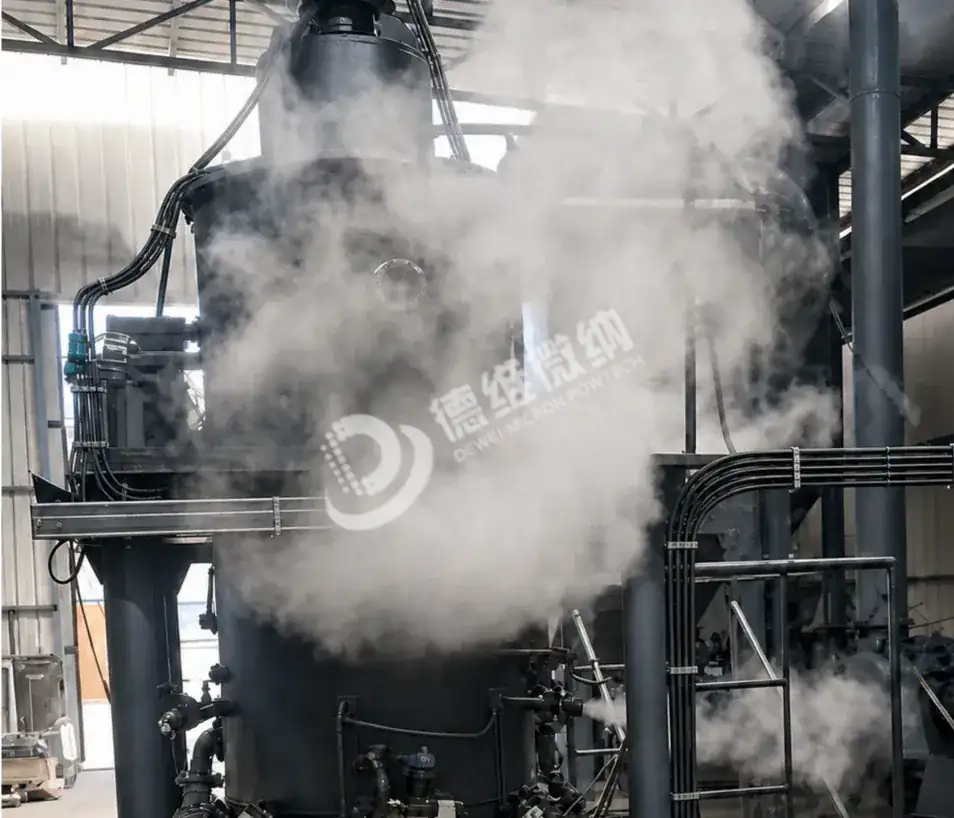
Each item is reviewed against the real powder and acceptance criteria.
Steam conditions can provide higher energy density than conventional compressed air.
The route is evaluated for selected large-capacity inorganic powder applications.
A classifier controls the product upper size and returns oversize material.
Steam quality, temperature, pressure, and condensation are part of the system boundary.
Nozzles, classifier parts, and contact surfaces are selected for abrasive powders.
Available steam source and downstream handling determine project feasibility.
Selected minerals, inorganic powders, high-temperature-resistant materials, and projects with suitable steam utilities and capacity targets.
Application examples are not a guarantee for an untested powder. Chemical compatibility, dust risk, and required product properties must be confirmed first.
Send the material name, SDS, feed PSD, target D50/D90/D97, capacity, impurity limits, temperature limit, and atmosphere requirements.
Submit Material Data| Factor | Typical Requirement | Engineering Note |
|---|---|---|
| Grinding medium | High-pressure steam | Utility quality must be confirmed |
| Target | Ultrafine grinding | Material-dependent |
| Project focus | Capacity + energy integration | Full system evaluation |
| Required data | Material, PSD, steam conditions | Feasibility review first |
Usually it is evaluated for heat-tolerant materials. Thermal sensitivity and product stability must be confirmed first.
No. Utilities, material properties, moisture effects, target size, and capacity determine whether steam is appropriate.
Confirm available steam pressure and quality, material thermal behavior, moisture limits, target PSD, output, wear, and collection requirements.
Testing helps establish achievable particle size, capacity trend, collection behavior, contamination risk, and the correct system boundary before production selection.
Scan to add WeChat
 Scan with your phone to start a chat